Problem
The course is configured to expire by date every year, but the reports indicate that some learners do not need to complete the course again for almost two years.
Solution
There are two ways to configure when a user’s certification expires after completing a course:
-
Expiration by lapse time (for example, 365 days)
-
Expiration by date (for example, December 31)
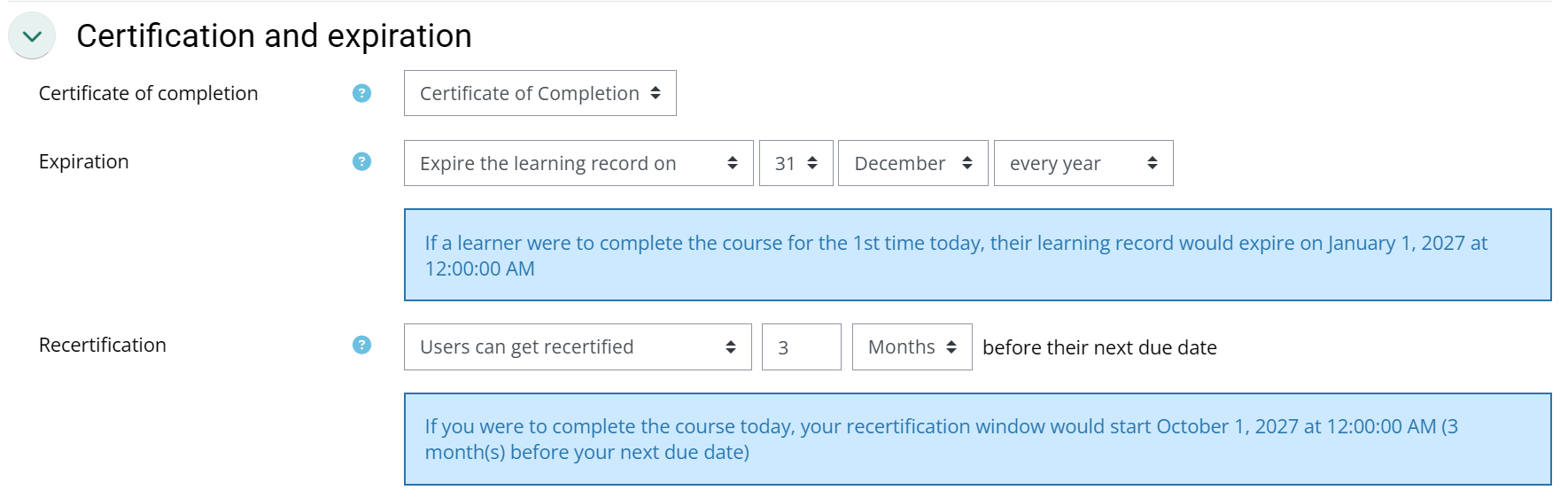
These two options are mutually exclusive and are configured in the course settings under Certification and expiration.
The Expiration by date option allows organizations to define a compliance cycle based on a fixed calendar period. When this option is used, it determines the date on which a learner’s learning record will expire after they complete the course. For example, if the setting is December 31, then regardless of when the learner completes the course, their learning record will expire on the upcoming December 31. In this example, the compliance cycle runs from January 1 to December 31.
When configured this way, users only need to complete the course once within each compliance cycle. This means that whether a user completes the course in January, June, or December, they are still considered compliant for that cycle.
Because the course is recurring, the learner must complete it again in the next compliance cycle. For example, if a user completes the course on October 15, 2025, they have satisfied the requirement for the January 1, 2025 to December 31, 2025 compliance cycle. They must then complete the course again during the next cycle, which runs from January 1, 2026 to December 31, 2026. Since due dates always represent the last possible day by which the learner must complete the course, reports will show a due date of December 31, 2026.
As a result, a user who completes a course in January 2025 with an end-of-cycle date of December 31 will remain compliant for all of 2025 and will see a next due date of December 31, 2026. This can make it appear as though they have almost 24 months before they are required to take the course again, but this is simply how fixed-date compliance cycles operate.
Important Notes
-
Under this model, learners cannot complete the course early or late for a given cycle. For example, a learner who completes the course in late 2025 has satisfied the 2025 cycle, not the 2026 cycle. Likewise, a learner who completes it in early 2027 would not be considered compliant for 2026.
-
An instructor can select any date. For example, if March 31 is selected, the compliance cycle would run from April 1 to March 31 each year.
-
You can configure a recertification window for any given course. For example, you can specify that users may only recertify within 3 months of their due date. In that case, the learner would only be allowed to complete the course again starting on October 1. Using a recertification window like this can reduce the gap between completions, so that users renew every 12 to 15 months rather than potentially close to 24 months. See the screenshot below for an example of how recertification windows can be configured.